What Is the Best Option for Replacing a Missing Tooth in Virginia?
Compare missing tooth replacement options in Virginia — dental implants, bridges, partial dentures, and full dentures — with honest pros, cons, and local guidance from Woodbridge.
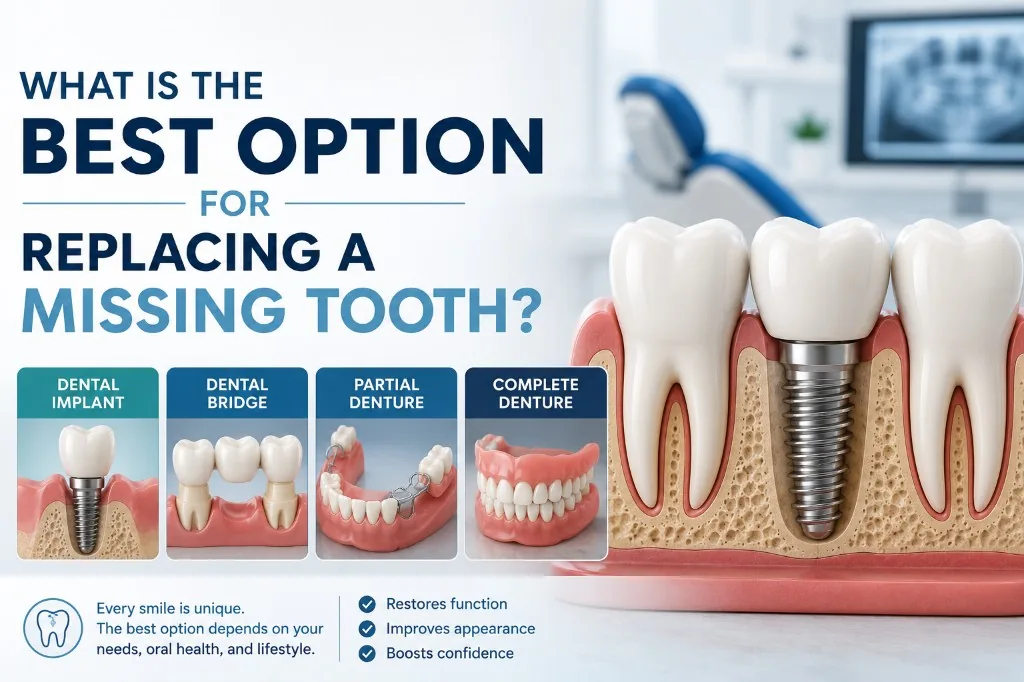
The best option for replacing a missing tooth depends on your bone health, budget, and how many teeth are missing — but for most healthy adults in Virginia, a dental implant is the strongest long-term choice because it replaces the root and crown without grinding down neighboring teeth. Bridges and partial dentures cost less upfront and work well in the right situations. This guide compares every major missing tooth replacement option so you can make a confident decision with your dentist.
What is the best option for replacing a missing tooth?
For a single missing tooth in a healthy adult, a dental implant is usually the best long-term option. It replaces both the root and the visible crown, stays fixed in place, and stimulates the jawbone the way a natural tooth root does.
A dental bridge is the next most common choice when an implant is not possible — for example, when bone volume is too low without grafting, or when cost is the primary concern. A bridge fills the gap by crowning the two teeth on either side and suspending an artificial tooth between them.
Removable partial dentures are the most affordable option for one or a few missing teeth, but they are less stable, do not prevent bone loss, and typically need adjustment or replacement every 5–10 years.
Doing nothing is always an option, but leaving a gap allows neighboring teeth to shift, increases wear on remaining teeth, and leads to gradual jawbone shrinkage that can make future replacement harder and more expensive.
Dental implants vs dental bridge — which is better?
Dental implants win on longevity, bone preservation, and independence from neighboring teeth. A single implant in Northern Virginia typically costs $3,500–$6,000 all-in and can last 20–30+ years with proper care. The implant post fuses with the jawbone during a healing period of three to six months before the final crown is placed.
A traditional bridge typically costs $2,500–$5,000 and can be completed in two to three weeks. The trade-off is that the dentist must remove enamel from the two adjacent teeth to support the bridge, and those teeth bear extra stress for the life of the restoration. Bridges usually last 10–15 years before needing replacement.
Choose an implant when you want the most durable, bone-preserving solution and can manage the longer timeline and higher upfront cost. Choose a bridge when adjacent teeth already need crowns, when surgery is not an option due to medical conditions, or when you need a faster, lower-cost fix.
Partial dentures vs implants for one missing tooth
A removable partial denture for one tooth clips onto nearby teeth with metal clasps. It costs roughly $500–$1,500 and can be made within a few weeks. The downside is stability — partials can move when chewing, trap food underneath, and the clasps may be visible when you smile.
Partial dentures also do not stimulate the jawbone. Over time, the bone under the missing tooth continues to shrink, which can change how the partial fits and alter facial appearance.
For one missing tooth, an implant is almost always the better functional choice if you are a candidate. A partial makes sense as a temporary solution while saving for an implant, or when multiple teeth are missing and a full implant plan is being phased over time.
When a bridge makes more sense than an implant
A bridge may be the better choice when the teeth on either side of the gap already have large fillings or crowns and would benefit from being crowned anyway. In that case, the bridge solves two problems at once.
Bridges also work well for patients who cannot undergo implant surgery due to uncontrolled diabetes, certain medications, heavy smoking, or insufficient bone that cannot be grafted.
If you need a replacement tooth within days rather than months, a bridge or temporary partial can restore appearance quickly while you plan a longer-term solution.
Dr. Christine Mai at Hedgewood Dental in Woodbridge evaluates each case individually — the right answer depends on your X-rays, medical history, and goals, not a one-size-fits-all recommendation.
Missing tooth replacement options in Northern Virginia
Patients across Prince William County and Northern Virginia have access to the full range of missing tooth replacement options: single implants, implant-supported bridges, traditional bridges, partial dentures, full dentures, and All-on-4 full-arch solutions.
At Hedgewood Dental in Woodbridge, VA, Dr. Mai plans implant cases with 3D imaging and coordinates with local oral surgery and periodontal specialists when surgical placement is needed. Patients from Dale City, Lake Ridge, Lorton, Dumfries, and surrounding communities typically complete a single implant in four to nine months.
For a detailed cost breakdown, see our guide to dental implant pricing in Woodbridge. To compare implant types — endosteal, mini, All-on-4, and more — read our article on the five types of dental implants available locally.
Frequently asked questions
How long do dental implants last compared to bridges?
Dental implants commonly last 20–30+ years with proper care; many last a lifetime. Traditional bridges typically last 10–15 years before the supporting teeth or the bridge itself needs replacement.
How much does missing tooth replacement cost in Virginia?
A single dental implant in Northern Virginia runs $3,500–$6,000 all-in. A bridge costs $2,500–$5,000. A partial denture for one tooth costs $500–$1,500. Full-arch options like All-on-4 range from $20,000–$35,000 per arch.
How long does it take to replace a missing tooth with an implant?
From consultation to final crown, most single implants take four to nine months. Most of that time is bone healing after surgical placement. Bridges and partials can often be completed in two to four weeks.
Does insurance cover missing tooth replacement in Virginia?
Coverage varies by plan. Some dental insurance covers a portion of the crown or bridge; many exclude implants entirely. Related procedures — extractions, bone grafts, periodontal treatment — are often partially covered. Hedgewood Dental verifies benefits before treatment.
Can I replace a missing tooth without surgery?
Yes. A dental bridge or removable partial denture replaces a missing tooth without surgery. These options do not replace the tooth root and do not prevent bone loss the way an implant does.
Choosing the best missing tooth replacement option comes down to your bone health, timeline, budget, and how long you want the result to last. At Hedgewood Dental in Woodbridge, VA, Dr. Christine Mai walks through every option — implants, bridges, and dentures — with clear pricing and no pressure. Schedule a consultation to get a personalized recommendation based on your X-rays and goals.
Request an AppointmentRequest an Appointment
Share a few details—our team will follow up to confirm next steps.